ChatGPT is adding interactive visual explanations for more than 70 maths and science concepts. OpenAI announced the feature on 10 March, with a rollout to logged-in users across all plans globally. Instead of receiving only a written answer, a learner can change variables and watch a diagram or graph respond.
The initial selection is aimed mainly at secondary-school and university-level learning. OpenAI lists subjects including the Pythagorean theorem, circle area, Ohm’s law, kinetic energy and the ideal gas equation.
A useful way to question a formula
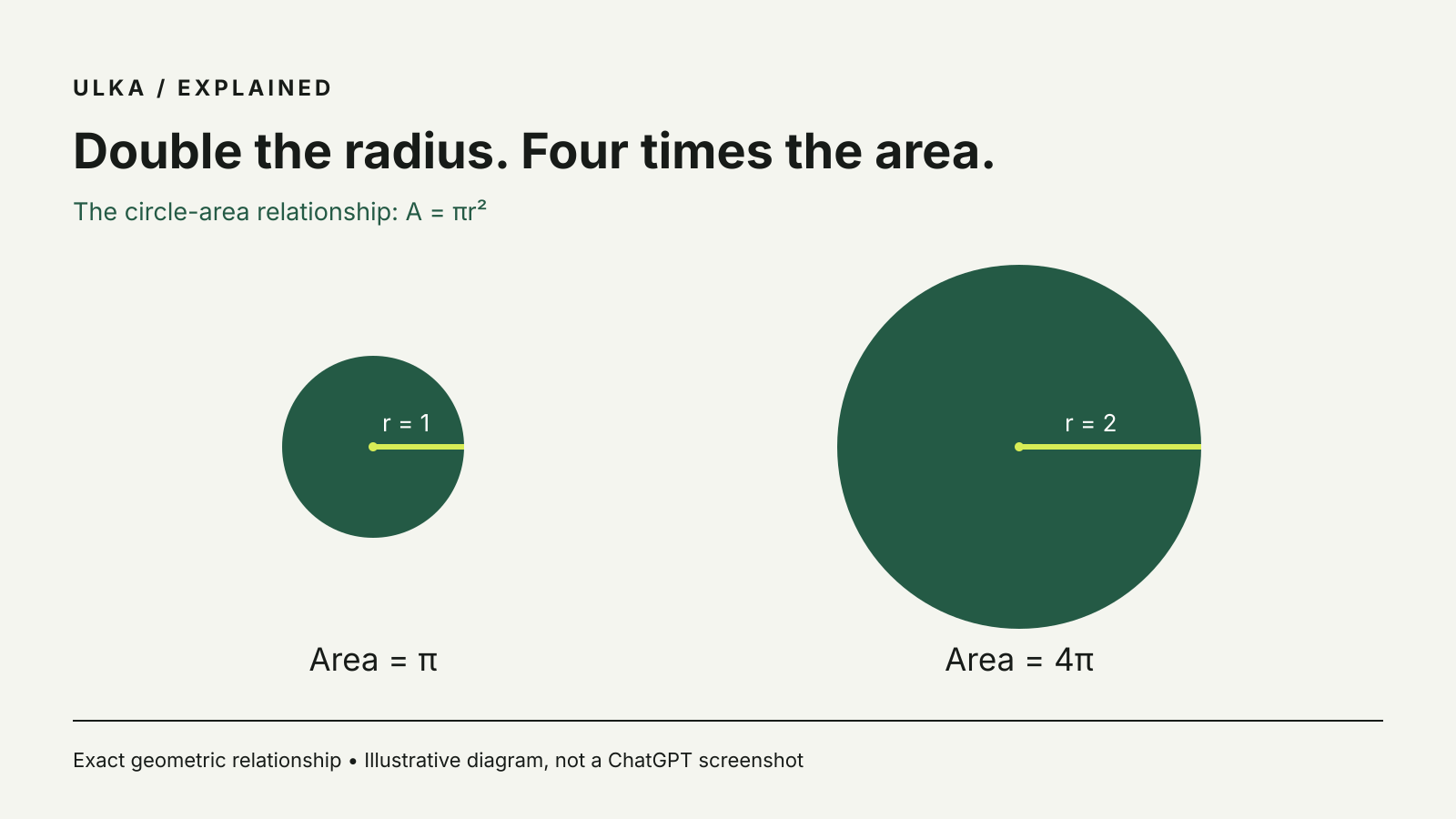
An interactive diagram can make a relationship easier to examine. With a circle, for example, doubling the radius multiplies the area by four because the area depends on the square of the radius. A student can predict that result, change the value and compare the prediction with what the diagram shows.
That sequence is more useful than moving a slider until the screen produces an attractive result. Start with a question about the relationship, make a prediction and then explain any difference. Ask the assistant to show the calculation as well, so the numerical result can be checked separately from the picture.
OpenAI says the modules can appear when users ask about a supported topic. Its examples include requests to explain the Pythagorean theorem or how the ideal gas equation works. The announcement does not say that every question in every subject will produce an interactive module.
Check the explanation as well as the visual
A responsive chart can make an answer feel persuasive even when a variable, assumption or unit needs correction. When using a module for study, check the definitions against your course material. In physics, identify which quantities are held constant and whether the equation is being used within its intended conditions.
The rollout follows ChatGPT’s existing study mode and quiz features. OpenAI reports positive early feedback from students, parents and educators, but that feedback is different from proof that the new feature improves exam performance or replaces instruction. Its announcement also acknowledges that research into AI and learning outcomes is still developing.
For a parent helping with homework, the most useful role may be to ask a child to describe what changed on the screen and why. If they can operate the visual but cannot explain the relationship in words, the underlying concept still needs work.
Keep a textbook or teacher-provided example alongside the conversation. Try the same calculation without the assistant afterwards, and compare the working steps. The feature provides another way to explore a concept; the learner still needs to recognise when a result makes sense.
Explore other assistant developments in AI Chatbots.
Source: OpenAI, “New ways to learn math and science in ChatGPT”, 10 March 2026. Diagram: the exact circle-area relationship, A = πr².