Cloudflare has added a managed web application firewall rule for a Ghost CMS vulnerability in its 15 June release. The changelog identifies CVE-2026-26980 as a blind SQL injection issue in the Ghost Content API, affecting versions 3.24.0 through 6.19.0.
For a website owner, the immediate question is whether the site runs an affected version and whether the relevant protection is actually applied to its traffic. The presence of a CDN or a hosting logo does not answer either question by itself.
Read the action column
Cloudflare lists a Ghost-specific rule with a new action of Block in its Managed Ruleset. The same release includes a generic detection for obfuscated boolean SQL injection, but that entry is listed as Disabled. The two rows therefore should not be described as if they provide identical active protection.
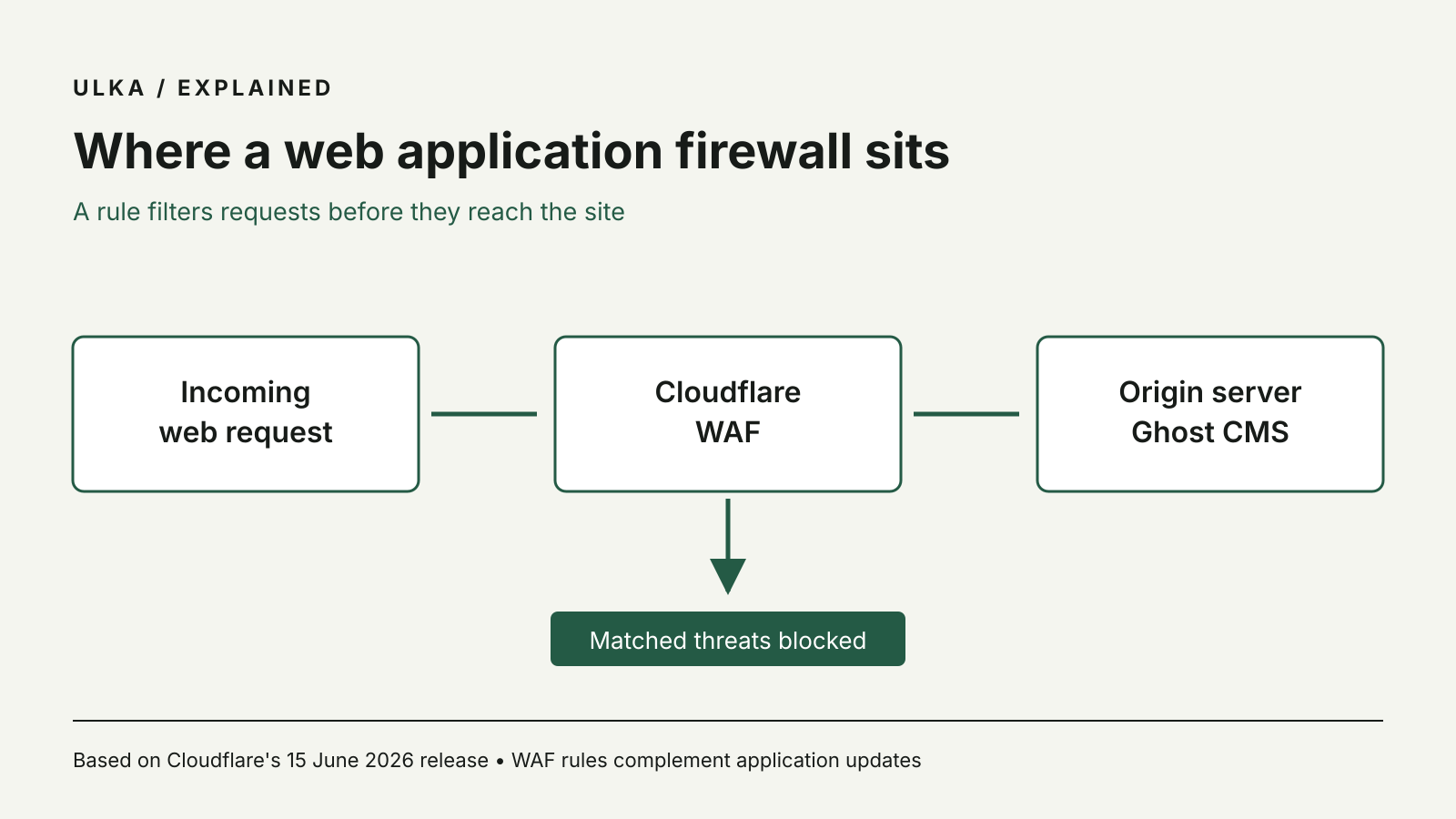
A web application firewall examines requests before they reach the application. It can reject requests matching a rule, giving a site an additional defensive layer. That is distinct from replacing vulnerable application code with a patched version.
The release note is Cloudflare’s account of the detection and affected software. Website operators should check the application vendor’s current security information and the actual installed version before deciding which update to apply. A protection rule should not become a reason to postpone that investigation.
What to ask a hosting provider
If someone else manages the site, ask for the Ghost version, the status of the relevant managed rules and any maintenance required. Also confirm whether the site’s public traffic passes through the protected route and whether the origin is exposed by another route. Those details determine whether an edge rule is relevant to the setup.
Changes to blocking rules deserve a functional check as well. After updating the application or enabling protection, test the site’s ordinary content requests, search and any integrations that depend on the API. A site can appear healthy at its homepage while a specific request path is failing.
Keep a recent, recoverable backup before application maintenance. Record the change and check the logs afterwards, so a problem can be traced to a specific update instead of several changes made at once. A backup is useful only if the operator knows how to restore it.
For a hosting comparison, this incident illustrates a practical service question: who handles software updates and security-rule changes, and how do they communicate their status? Managed hosting can cover different tasks at different providers, so ask for the responsibilities in concrete terms.
Read more about maintenance and service selection in Hosting Services.
Source: Cloudflare Developers changelog, “WAF Release - 2026-06-15”, 15 June 2026. Diagram shows the request path through a web application firewall; it is not a screenshot of a hosting dashboard.