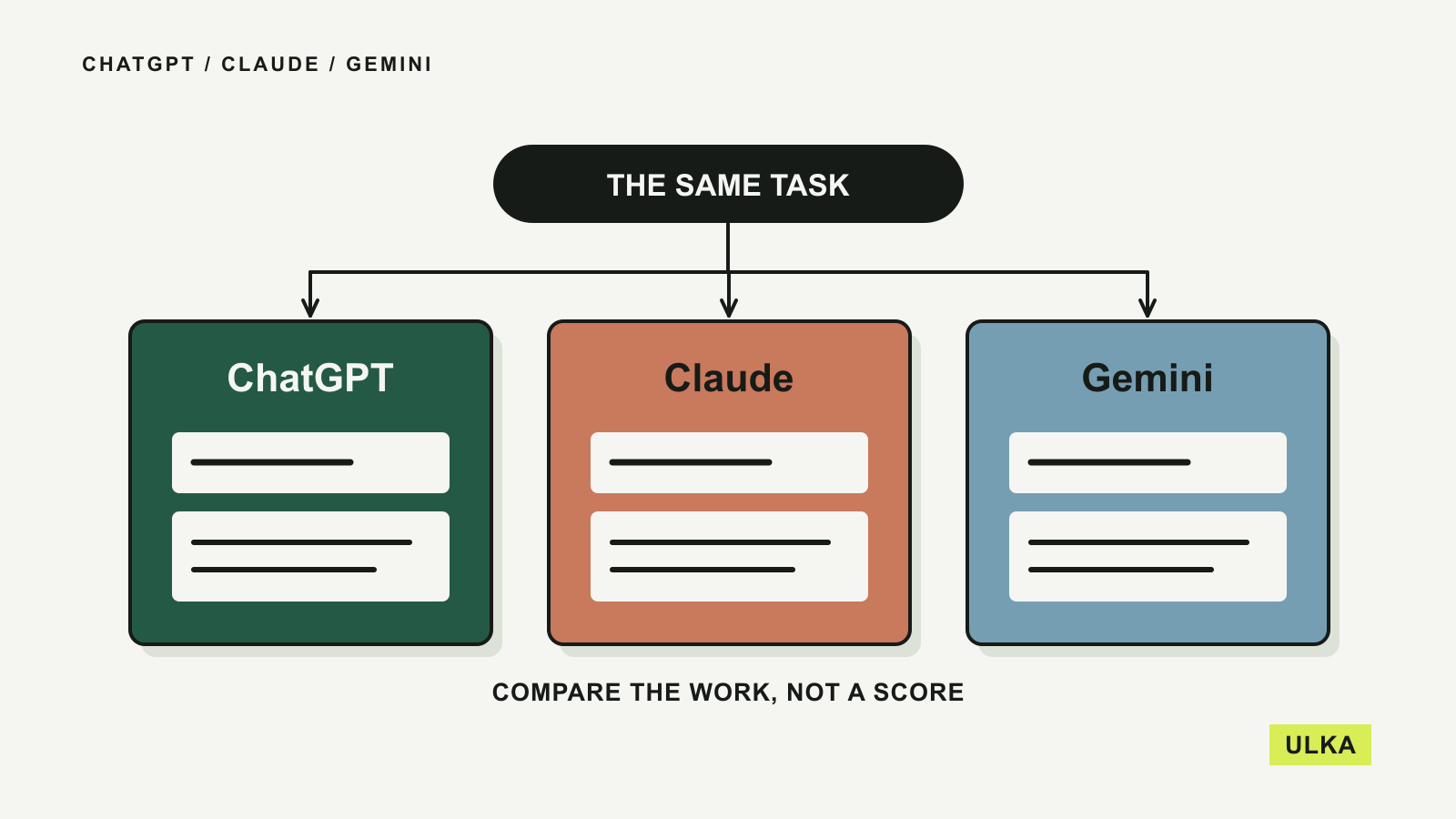
Choosing between ChatGPT, Claude and Gemini becomes easier when you give each the same document task and follow it through a revision. The first answer is only part of the job. You also need to preserve source facts, resolve missing information and move the result into the application where you will use it.
This guide compares that workflow using documented features checked on 26 September 2026. It provides a trial you can run with your own non-sensitive material; it does not present measured results or declare a winner for answer quality. For a broader shortlist that includes Perplexity and Microsoft Copilot, see our AI chatbot guide.
What each product brings to the task
The three services overlap, but their working environments give you different things to examine. Check the features in your actual account before starting. A brand name alone does not establish which tools, settings or limits apply.
| Part of the job | ChatGPT | Claude | Gemini |
|---|---|---|---|
| Set up the work | Check the available work tools and file access | Use a Project for a reusable reference set and instructions | Choose files and supported sources in Deep Research |
| Shape the output | OpenAI documents creating and editing documents, spreadsheets and presentations | Artifacts provide a separate area for substantial outputs | Deep Research starts with an editable research plan |
| Continue editing | Check the resulting file in your usual application | Try a targeted artifact edit and its version controls | Review the report and its export to Google Docs |
| Main question for your trial | Does the final deliverable need much repair? | Do repeated revisions preserve the source facts? | Does the plan keep the report within the agreed scope? |
These are useful entry points, not exclusive capabilities. A documented export button, project workspace or research mode cannot establish whether a particular answer is correct.
Prepare one small reference pack
Choose a task you understand well enough to check. A useful example is turning a short project proposal and a table of dates into a one-page briefing. Use ordinary material with no private client details or workplace information you are not permitted to upload.
Before starting, make your own note of the facts that must survive: names, amounts, deadlines and any conditions attached to them. Identify one piece of missing information. If the files contain conflicting versions of a date, record the conflict rather than silently fixing it for the assistant.
Keep the source files and the instruction identical across services. Record the account tier, selected mode and date alongside each result. If one tool uses web research and another only reads your files, you are comparing different tasks. Start with the same source boundary, then examine extra capabilities separately.
For the first pass, an instruction like this is enough:
Prepare a one-page briefing using only the supplied files. Preserve the stated dates, amounts and conditions. Identify missing information and conflicts without guessing. Name the file supporting each important fact. End with the decisions that still need an owner. Use Australian English.
The instruction gives you something concrete to assess. It also makes an unsupported deadline or invented owner easier to recognise.
ChatGPT: inspect the deliverable you take away
OpenAI’s ChatGPT overview describes work tools that create and edit documents, spreadsheets, presentations, charts and other deliverables. For this trial, request the briefing in the format you normally need, provided that format is available in your account.
Read the content before judging the layout. Compare every date and amount with your reference note. Check whether a condition has disappeared during summarising, and whether a reference names the correct file rather than merely sounding plausible.
Then open the output in its destination application. Can you edit the headings, copy a table and make a small change without rebuilding the document? If you asked for a spreadsheet, inspect formulas as well as displayed totals. Record the repair work required after export.
ChatGPT’s range of outputs may be useful when one brief also needs a chart or image. OpenAI separately documents creating and editing images, including selection-based edits. Keep that as a separate trial: an attractive picture should not affect the score for a factual document.
Claude: test a reference set through a revision
Claude Projects provides a workspace with uploaded knowledge and project instructions. Add the same reference pack and keep any instructions visible and specific. A reusable project is convenient only if you can tell which documents are current.
Ask for the briefing as an artifact. Anthropic describes a separate output area with editing, version selection and file download. Its current documentation requires Code execution and file creation to be enabled for artifacts, including the relevant organisation setting where applicable.
Make a precise follow-up request: shorten the background section, preserve the dates and amounts, and leave the unresolved questions unchanged. Compare the entire revised version with the previous one. Look beyond the requested section for dropped conditions or altered facts.
Use the version controls and download the result. A useful workflow should let you recover an earlier version and continue editing outside the conversation when needed. Also check the source references after revision; a corrected paragraph can still retain a citation that no longer supports it.
Gemini: separate file work from research scope
Gemini Deep Research produces a plan you can edit before research starts. Google Search is selected by default, and Google documents additional sources including uploaded files, NotebookLM notebooks and connected Gmail or Drive content.
For the shared-file trial, inspect the source selection and plan before continuing. Keep the scope within the supplied material. If your available mode cannot do that, record the difference instead of treating a web-enriched answer as an equivalent result.
A second, separate trial can examine a question that genuinely needs current sources. For example, ask which requirements in your proposal depend on a product’s present Australian availability. Review whether the plan specifies Australia, official documentation and the relevant date. A broad global comparison would answer a different question.
Google also documents export to Docs. Inspect the exported report, its headings and source links. Follow a citation all the way to the relevant statement rather than accepting the report’s interpretation. Google’s Gemini overview acknowledges that responses can be inaccurate or misleading.
Apply the same revision to all three
After each first draft, give the same follow-up instruction. Changing the audience is a useful test because the explanation must change while the facts stay stable. Ask for a version for a colleague unfamiliar with the project, with one section shortened and all stated commitments preserved.
Check whether the assistant follows the requested scope. An unrequested rewrite may force you to verify the whole document again. An answer that becomes simpler by removing an important qualification is also a failed revision, even if it reads smoothly.
Keep corrections distinct from preferences. A wrong date is a factual error. A heading you would phrase differently is an editing preference. A broken table is a usability problem. Separating them prevents a polished style from hiding the most consequential mistake.
Compare the work left to do
Use a small comparison sheet with one row per service and the same observations for each:
| Record | What counts |
|---|---|
| Factual corrections | Wrong or missing facts checked against the source pack |
| Revision problems | Unrequested changes, lost conditions or unresolved instructions |
| Source problems | Missing references, wrong files or links that do not support the statement |
| Handover work | Reformatting, broken exports or edits needed in the destination application |
| Repeatability | Whether you can find the work and run the same process again |
Do not convert these observations into a universal intelligence ranking. They tell you which service fits this particular task, account and workflow. Repeat the exercise with a second representative document before making a long subscription commitment.
Choose the subscription after the workflow
Check the plan that supplies your useful tools, including file, research and other relevant limits. Compare the displayed currency, billing period and renewal conditions. Australian English and AUD should be explicit in your brief when they matter; neither follows automatically from the service’s global branding.
Read the data controls for the actual account type. An organisation’s approved account may have different conditions from a personal subscription. If connected tools can send or change something, set the permitted actions before starting; our AI agents guide explains that distinction.
Choose the service that leaves you with an accurate, editable result and a manageable checking process. You may find that one is convenient for recurring documents while another suits occasional research. That conclusion is more useful than paying for all three on the strength of an impressive first answer.
Questions
Is ChatGPT better than Claude or Gemini?
This guide does not establish a universal winner. Compare the same task and source material, then judge accuracy, revisions and the work required to use the result.
Should I use Claude Projects for a single document?
A project is most relevant when you expect to reuse a reference set. For one document, focus on whether the output and editing process suit the task.
Should Gemini Deep Research search the web in this trial?
Keep the initial comparison within the same supplied files. Test web research separately, with an explicit question, source scope and date requirement.
What should I check after an AI assistant revises a document?
Review the whole result for changed facts and lost conditions, then check references and the exported file. The requested section is only part of that review.
Sources
- OpenAI: ChatGPT overview and creating images in ChatGPT.
- Anthropic: Claude Projects and artifacts.
- Google: Deep Research in Gemini Apps and Gemini overview and limitations.
Product documentation consulted 26 September 2026.