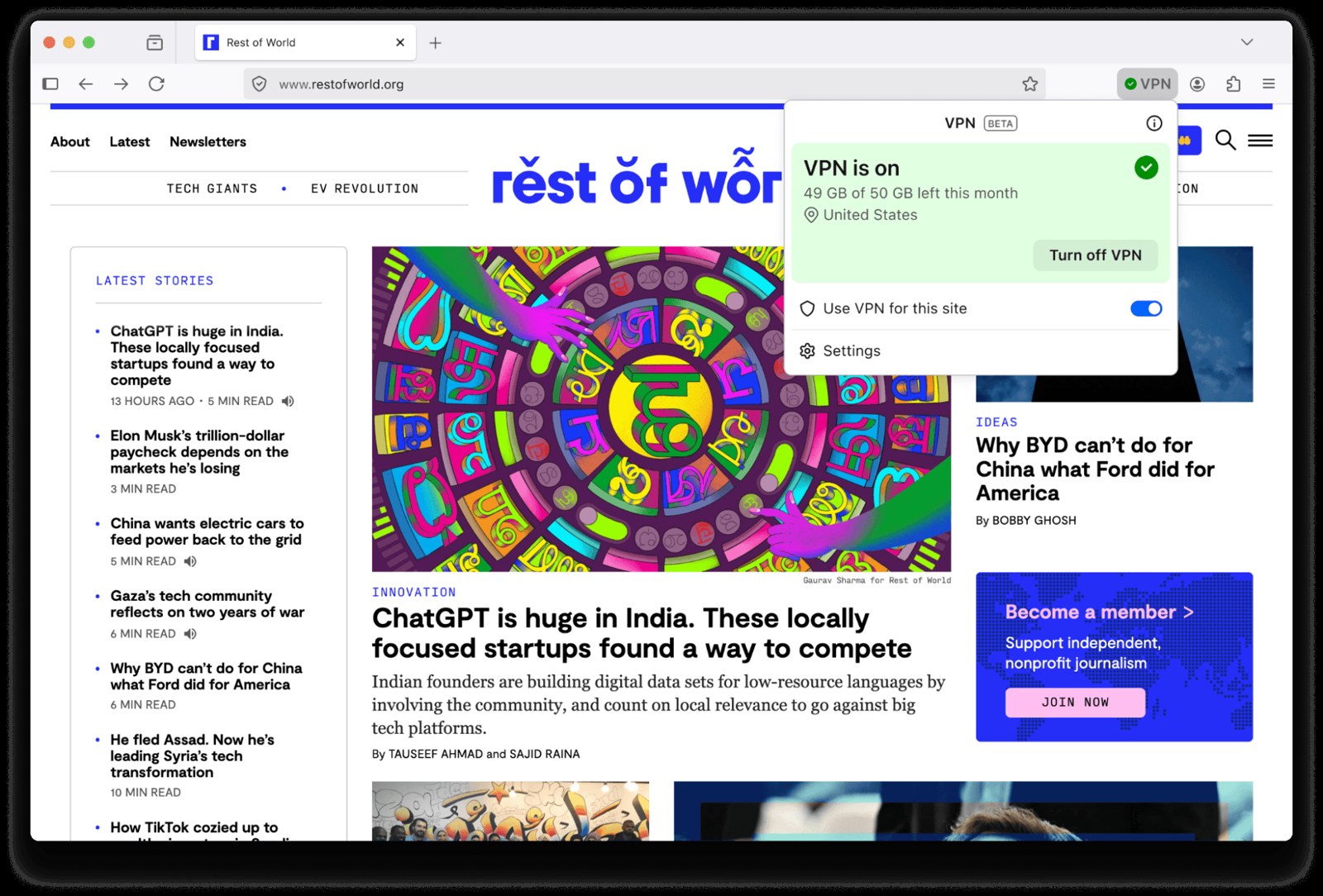
Firefox 149 has begun rolling out a free built-in VPN with a 50GB monthly allowance. Mozilla’s release notes, dated 24 March, list the United States, United Kingdom, Germany and France as the first supported countries. Australia is not included in that initial list.
The feature routes Firefox browsing through a secure proxy to hide the user’s IP address and location from the websites being visited. Users need to sign in and enable it, and can turn it on or off for individual websites.
Browser protection has a defined boundary
The scope is Firefox browsing. Mozilla describes the feature separately from its paid Mozilla VPN service, which provides protection at the device level. That difference matters if the connection you want to protect comes from a game, email application or another browser.
It is also important to distinguish IP protection from anonymity. Signing in to a website still identifies you to that account, and a VPN does not make a fraudulent download safe. The useful question is which traffic the product routes and what information it changes for that traffic.
The 50GB allowance makes usage another practical consideration. A browser feature may suit occasional browsing while being a poor match for a large amount of video streaming. Mozilla’s country restriction also means Australian users should not assume that updating Firefox will reveal the new control.
A gradual release, with other changes included
Mozilla calls this a progressive rollout, so even users in the supported countries may receive it at different times. The launch material also says the feature is not being rolled out in enterprise environments with enterprise policies. A managed work computer can therefore behave differently from a personal machine.
Firefox 149 includes changes that have wider immediate relevance. Split View can place two pages beside each other in one window, which is useful when comparing information or checking a source while writing. Mozilla has also enabled address autofill in Australia, India, Italy, Poland and Austria.
Another security change automatically blocks notifications and revokes notification permissions for sites flagged as malicious by SafeBrowsing. That addresses a different problem from IP privacy: unwanted or deceptive messages continuing to arrive from a website in the background.
For an Australian reader comparing VPN options, the first check remains availability. After that, compare browser-only coverage with the applications you actually use and assess the monthly allowance. A feature being free is helpful only when its coverage fits the task.
ULKA’s VPN section covers service features and the limits of the technology.
Sources: Mozilla, Firefox 149.0 release notes, 24 March 2026; Mozilla Connect, “Introducing Firefox’s Built-in VPN: IP protection, now in the browser”, 24 March 2026. Interface image: Mozilla.