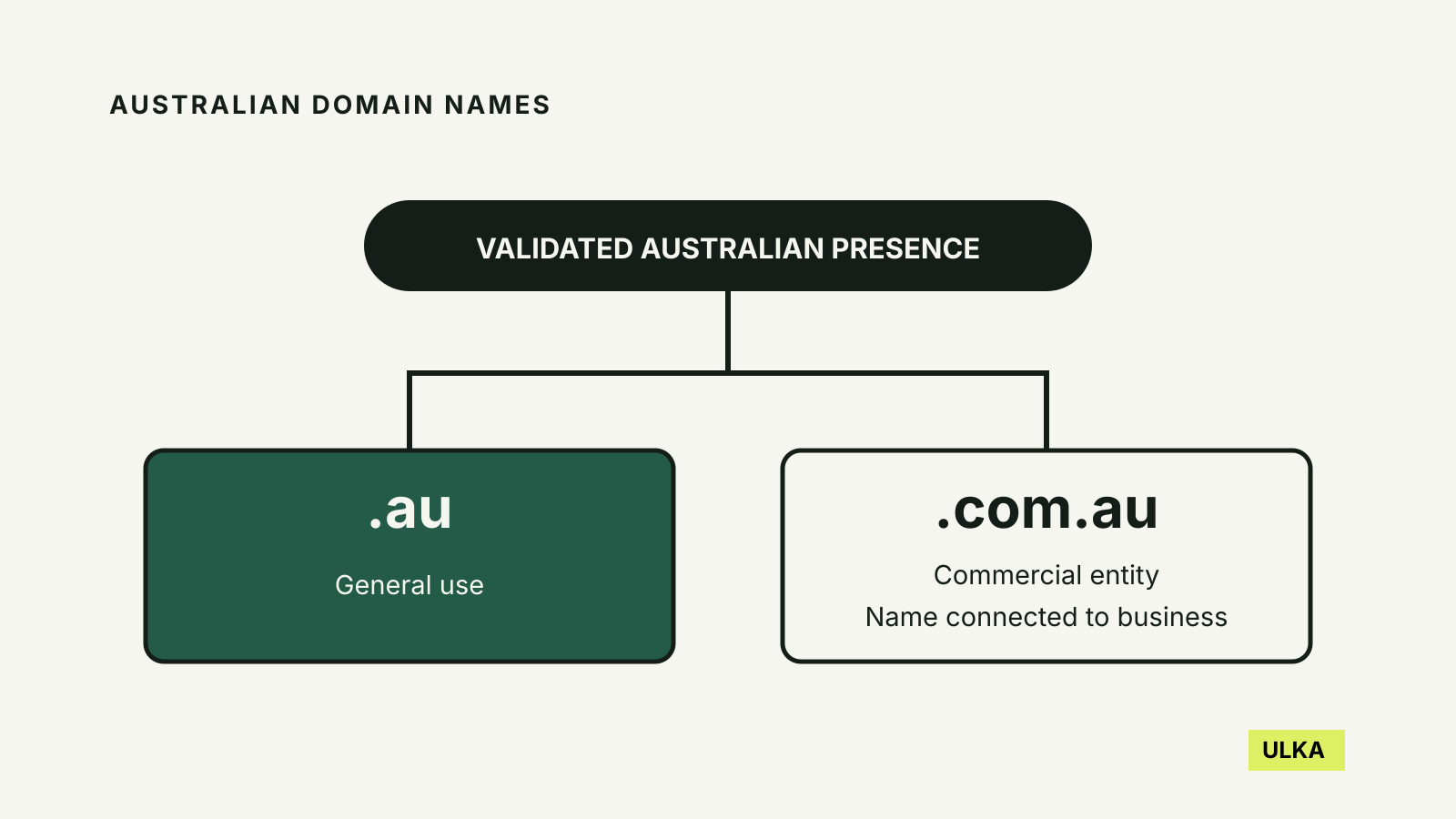
To register an .au domain, first choose the namespace and confirm that you meet its eligibility rules. A direct .au name is open to people and organisations with a validated Australian presence. A .com.au name has additional requirements: it is for a commercial entity, and the chosen name must connect to the business.
The short ending is not simply a cheaper spelling of the longer one. Decide who will hold the licence and which rules that person or organisation can satisfy before comparing a domain provider’s offer.
This guide follows auDA’s official Australian Presence and .au direct documentation, checked on 10 October 2026. It gives a practical preparation checklist without recommending a particular registrar or quoting an unverified current price.
Choose between .au and .com.au
auDA describes .au direct as a general-use namespace. It can suit a personal project, portfolio, event, community organisation or business, provided the registrant meets the Australian Presence requirement and can use the chosen available name.
For .com.au, auDA says you must be a commercial entity with a connection to Australia and the name must connect to the business. An available name is therefore only part of the decision. Check the allocation rules for the namespace rather than assuming an ABN lets you register any business-looking address.
| Question | .au direct | .com.au |
|---|---|---|
| Who is it for? | General use with validated Australian presence | A qualifying commercial entity |
| Must the name connect to a business? | auDA permits an available name you are allowed to use | The name must connect to the business |
| Does .au replace .com.au? | No | auDA says it is not being phased out |
You do not have to register matching versions in both namespaces. If you choose to do so, each registration must independently meet its rules. A redirect can send the additional address to the primary site, but acquiring two licences is still a separate choice.
Prepare evidence of Australian presence
Common ways to meet the requirement include an Australian citizen or permanent resident, an organisation registered in Australia, or a holder of an Australian trade mark. A valid ABN or ACN is one route, not the only route for .au direct.
auDA says the domain provider validates evidence when a name is created, renewed or transferred to a new registrant. Its examples include an ABN or an Australian-issued driver’s licence. The exact evidence depends on the basis on which you apply.
Use your own accurate details and provide them through the provider’s legitimate registration process. Do not send identity documents to somebody who has merely offered to secure a name in a message. If your case does not fit the common examples, check the Australian Presence definition in the current Licensing Rules before paying.
The eligibility requirement continues after the first purchase. Keep records current and retain a way to show the connection if the provider needs to validate it again.
Make sure the licence belongs to the right registrant
A developer can register an .au direct domain on your behalf with your explicit written permission. auDA says the application should use your details, including your own company’s ABN where applicable.
That matters because the registrant information in the .au registry determines who holds the licence. Paying an invoice for a website is not a substitute for checking whose name is recorded.
Before the order is submitted, confirm the registrant’s legal name, contact details and eligibility information. If the domain is for a business, agree who will administer it and how the business can recover access when a developer or employee leaves.
Keep the registration account distinct from the website’s publishing account where practical. Record the provider and renewal date in a place the registrant can access, rather than leaving the only reminder in a contractor’s inbox.
Compare the actual offer
Check availability with your chosen domain provider and confirm that the proposed registrant and name meet the namespace rules. Read the licence term, total checkout cost and renewal price before proceeding.
auDA says .au direct licences can be registered for one, two, three, four or five years at a time. Not every provider offers all of those terms. A renewal is conditional on continuing to meet the requirements.
For a price comparison, use the same namespace and term for each offer. Check what happens after any introductory period and whether the quote includes tax or optional extras. This guide does not give a universal retail price: use the provider’s current offer.
Domain registration, web hosting and email are different decisions. A bundle can be convenient, but check which services the quoted amount buys and whether you need all of them. Our hosting services guide helps you compare the hosting part separately.
Connect the address to what you actually need
auDA says you do not need an active website to hold an .au direct domain. You can use it for an email address or retain it for a future project while continuing to meet the eligibility rules.
If you are connecting a website, follow the current instructions from your domain provider and host. If you are connecting email, follow the mail provider’s requirements. Changing a domain setting without checking its purpose can interrupt an existing service, so note the current configuration before making a change.
For multiple names, choose a primary address and ask the provider about a redirect for the others. A redirect does not remove the extra names’ registration and renewal obligations.
Keep a renewal and access checklist
Save the provider, registrant, term, expiry and a working contact method. auDA says you can check .au expiry through the provider’s dashboard or its Password Recovery Tool. Check the actual recorded date rather than relying on the date you first launched the website.
Review the account before the renewal window: can the right person sign in, are contact details still correct and does the registrant still satisfy the rules? Secure access using a supported second factor and keep its recovery method available.