Can you use AI images commercially? On the four big services checked here, the terms say yes in most cases: OpenAI, Midjourney, Google and Canva all let you use what you generate, and none of them claims ownership of it. The catches sit in the detail: who owns an image built on someone else’s work, what a business has to pay, and what the terms cannot promise you about copyright.
This guide reads the current terms of OpenAI, Midjourney, Google and Canva, checked on 19 October 2026. Terms change, and they are not legal advice; if an image matters to your business, read the version in force when you make it.
What each service says
| Who owns the output | Main conditions | |
|---|---|---|
| OpenAI (ChatGPT, image tools) | You, assigned by OpenAI | Output may not be unique; don’t present it as human-made |
| Midjourney | You, even after you cancel | Companies grossing over US$1 million a year need Pro or Mega |
| Google (Gemini and other services) | Google won’t claim ownership | Not for training other AI models |
| Canva | You, except where it uses Canva’s library content | Library photos and elements stay licensed, not owned |
OpenAI: ownership is assigned to you
OpenAI’s Terms of Use say that, as between you and OpenAI and to the extent the law allows, you keep your rights in what you put in and you own the output. OpenAI also assigns to you any right, title and interest it has in that output.
Two conditions matter for commercial work. First, OpenAI says output may not be unique: another user can receive something similar, and your rights do not extend to their output. Second, you are responsible for the content, including making sure it does not break the law or the terms, and you must not represent output as human-generated when it was not.
Midjourney: yours, with a revenue threshold
Midjourney’s page on using images commercially says you own the images and videos you create, and that this continues after your subscription ends. The exception is upscaling: if you upscale an image another person made, it still belongs to its original creator.
The main commercial condition is about size. A company with more than US$1,000,000 in gross revenue a year must be on the Pro or Mega plan to use Midjourney images commercially. Midjourney also says it cannot give guidance on copyright, that copyright laws differ from country to country, and recommends asking a lawyer.
Google: no ownership claim, one firm restriction
Google’s Terms of Service say that some of its services let you generate original content and that Google won’t claim ownership of it. The same terms warn that some generated content may not be suitable for everyone.
The restriction to note is on reuse for AI: the terms bar using AI-generated content from Google’s services to develop machine learning models or related AI technology. Using a generated image in a brochure, a slide or a post is a different matter; building a training set from it is not allowed. The terms also bar using the services to violate anyone’s legal rights, including intellectual property.
Canva: check what the image is built on
Canva’s AI Product Terms say you own your output, with one significant exception: output that modifies or incorporates licensed content from Canva’s library. If you use an AI tool to edit a library photo, you won’t own the result. In a presentation that includes library photos, you own the presentation, but the photos remain licensed to you under Canva’s content licence.
Canva also says output may not be unique, that you may use output for any lawful purpose at your own risk, and that you must have the rights to whatever you upload as input.
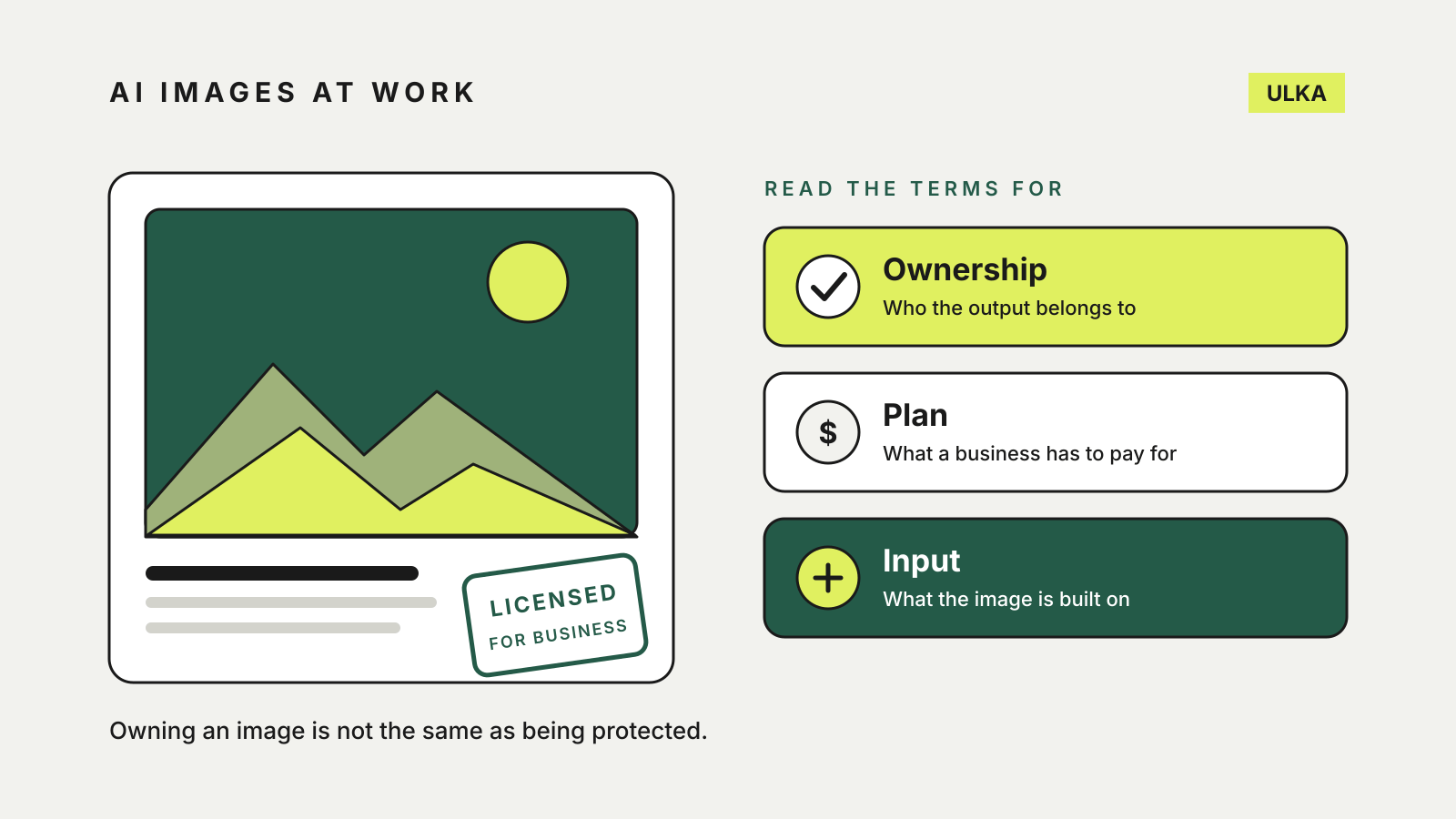
Owning it is not the same as being protected
All four sets of terms deal with the relationship between you and the service. They decide whether the company will claim the image; they do not guarantee that the image is free of someone else’s rights, or that anyone else is barred from making a near-identical one. Three points follow from the terms themselves:
- Similar images happen. OpenAI and Canva both say output may not be unique. Avoid building a logo or trademark on an image another user could plausibly generate too.
- Your input is your responsibility. Canva requires rights to what you upload, and OpenAI makes you responsible for your content. A prompt image you don’t have rights to can taint the result.
- Copyright is local. Midjourney points out that copyright laws differ between countries. For a business in Australia, that means Australian law decides what protection an image has, whatever the platform’s terms say.
A practical checklist before you publish
- Check your plan. On Midjourney, a business over the revenue threshold needs Pro or Mega.
- Check what went in. Don’t upload photos, artwork or logos you have no rights to, and note when an image edits library content, as on Canva.
- Keep a record. Save the prompt, the date, the service and a copy of the terms in force at the time.
- Avoid look-alikes. Don’t prompt for a living artist’s style, a brand’s characters or a real person’s likeness.
- Label honestly. OpenAI’s terms bar passing output off as human-generated, and our guide to telling if an image is AI-generated shows how readers spot it anyway.
For choosing a service in the first place, see our comparison of AI image generators.