To prevent SIM swap fraud, add every extra check your telco offers to your account, such as a PIN or biometric verification, move important logins off SMS codes, and never share a one-time code with someone who contacts you first. ACMA’s $277,200 penalty against Telstra, announced in September 2026, shows what happens when a telco skips its checks: the regulator found 15 unauthorised SIM swaps between January and October 2025, and affected customers reported losses of at least $39,500.
What a SIM swap actually is
A SIM swap happens when someone convinces, tricks or bribes a telco into moving your phone number onto a SIM card they control, usually after gathering enough of your personal details to pass as you over the phone or in a chat. Once they hold your number, they can receive the SMS codes banks and other services send to verify your identity, and use them to reset your passwords and drain accounts before you notice your own phone has lost signal.
Phone numbers have become an attractive target precisely because so many services still fall back to SMS for two-factor authentication. A text message that reaches the wrong SIM can unlock a bank account, an email inbox or a cryptocurrency wallet within minutes, which is why regulators now treat a telco’s identity checks at the point of a swap as a frontline defence, not a formality.
The checks telcos are required to run
Telcos must verify a customer’s identity before porting a number or swapping a SIM, and ACMA says Telstra’s frontline staff did not follow the telco’s own required authentication steps in those 15 cases. It also found 13 cases where Telstra did not offer extra fraud protection to customers who had raised concerns or were already known to be at risk. Information Age reports that ACMA set the penalty at $19,800 for each contravention, about twice the $9,520 average applied to Exetel. Alongside the fine, Telstra gave court-enforceable undertakings to strengthen its fraud-prevention processes and retrain customer-facing staff. It is Telstra’s second penalty under these rules: it paid $1.551 million in July 2024 for failing to use required identity checks.
Telstra is not the only telco ACMA has acted against. In a May 2026 update, the regulator said it had finalised 12 investigations into mobile number fraud during the 2025-26 financial year, issuing $4.6 million in penalties, while consumer reports of porting fraud fell 72 per cent compared with the previous year.
What you can set up now
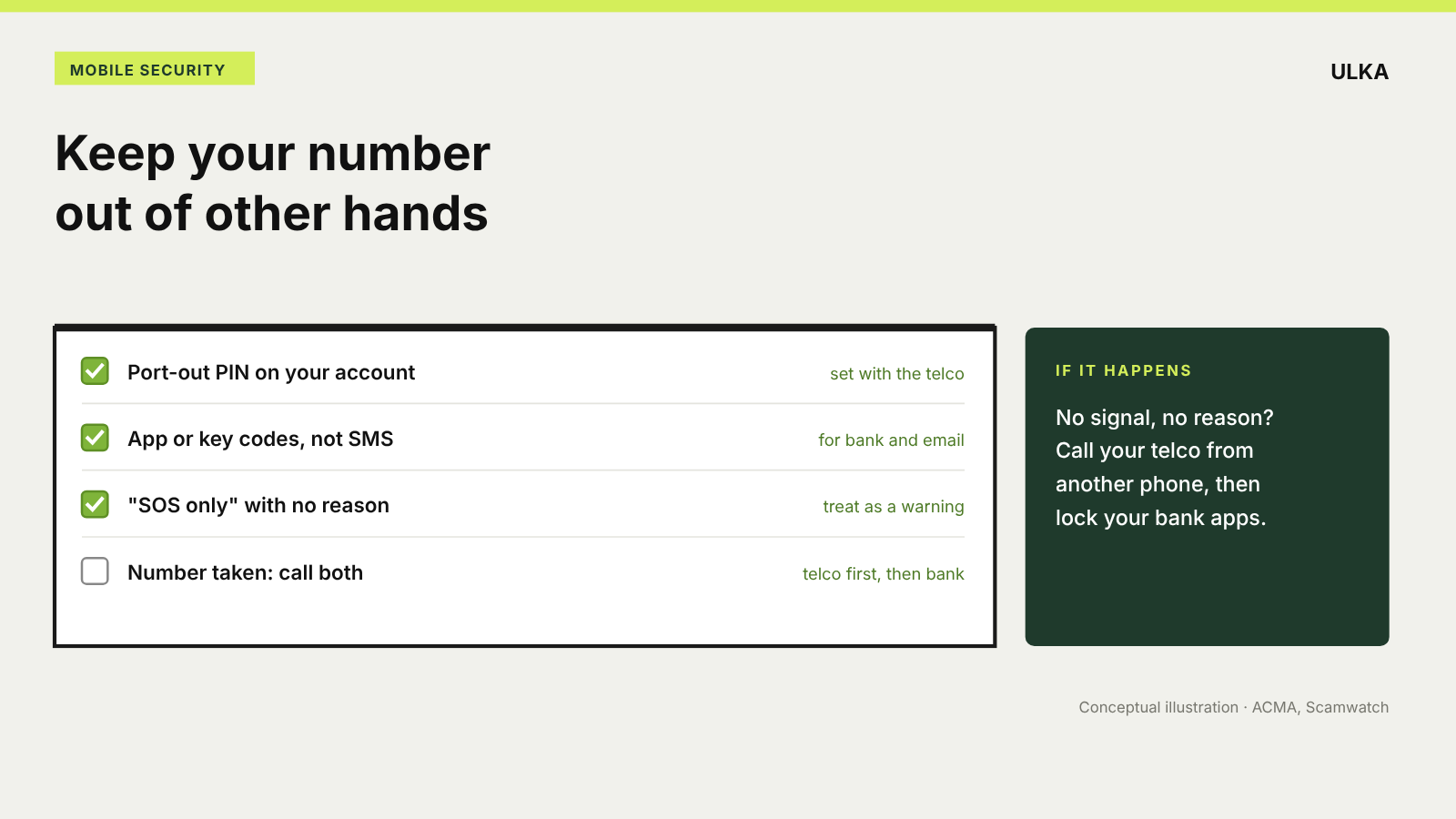
- Ask your telco what extra account protection it offers, and turn it on. Telstra, for example, lets customers add two-step verification in the My Telstra app using biometrics (face or fingerprint) or a Telstra PIN. Other telcos have their own options, so ask before you need them.
- Never give your PIN or a one-time code to anyone who calls or messages you first. Treat any unexpected request for a code as a scam, even if the caller knows some of your details.
- Move sensitive accounts off SMS-only two-factor authentication where you can. An authenticator app or a security key is not exposed if your number is swapped, which removes the main reason SIM swapping is worth attempting in the first place.
- Limit what is publicly findable about you. The more of your personal details are easy to find online, the easier it is for someone to pass a telco’s identity checks as you.
Warning signs your number has already been swapped
The clearest sign is a sudden loss of signal, often showing as an “SOS” or “no service” message when your phone was working normally moments before. Unexpected password-reset emails, login alerts you did not trigger, or a bank app you suddenly cannot access are also signs worth acting on immediately rather than waiting to see if they resolve on their own.
If it happens to you
Contact your telco straight away and ask it to reverse the unauthorised port or deactivate the fraudulent SIM and issue you a new one. Contact your bank at the same time, since a stolen number is often used to get into mobile banking next. From there, report the incident to Scamwatch and contact IDCARE, Australia’s identity and cyber support service, if your personal details were compromised beyond the phone number itself.