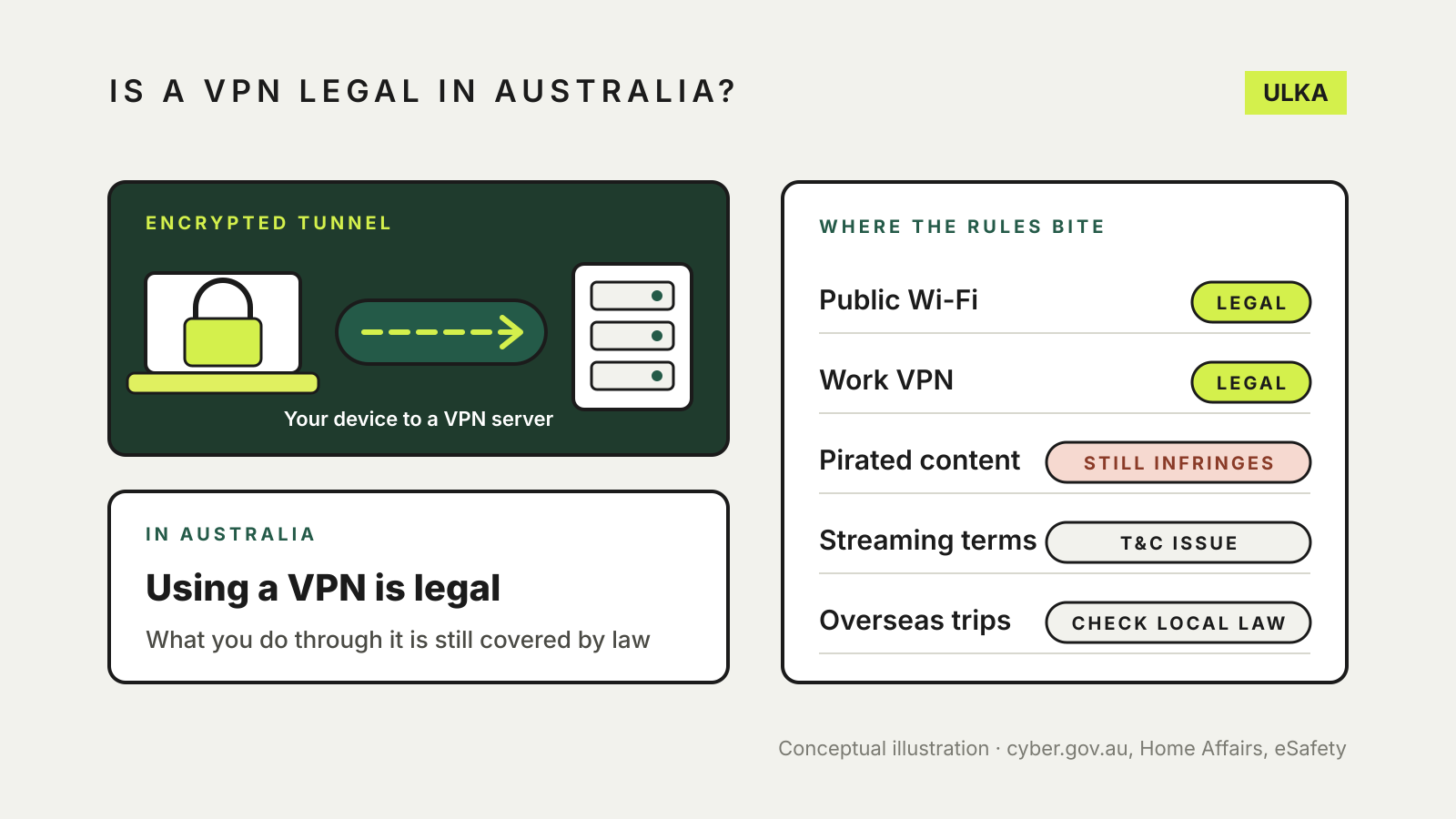
Yes, a VPN is legal in Australia. The Australian Government’s own cyber security agency recommends using one on public Wi-Fi, and the laws that mention VPNs regulate telcos, courts and online platforms rather than your choice to use one. What a VPN does not do is make an illegal act legal, and it does not override the rules of the services you sign in to.
This guide covers the Australian rules that actually touch VPN use: what your internet provider must keep, how court-ordered site blocking works, the social media minimum age and streaming terms. It also covers what changes when you travel. Government and service pages were checked on 6 November 2026. It is general information, not legal advice.
The government recommends VPNs
The Australian Signals Directorate’s cyber.gov.au site recommends VPNs in its everyday advice. Its guide to securing your mobile phone says to “consider using a VPN on your phone when using public Wi-Fi”, or to use mobile data instead.
Its remote working tips say a VPN “can help protect you when using a public network” by hiding your activity from other users on the same network. The same page adds two limits: a VPN “won’t protect you from threats such as malware, phishing or software security flaws”, and not all VPNs offer the same security, so choose a reputable provider.
Our guide to using a VPN on public Wi-Fi covers that situation in detail.
What your internet provider keeps
Australia’s data retention scheme applies to telcos and internet providers, not to you. The Department of Home Affairs’ data retention guideline says providers must keep certain information about communications for at least two years, and subscriber details for the life of the account plus two years.
The same guideline lists what they are not required to keep: the content of communications and, for internet access services, the addresses you visit, which it describes as “internet browsing history”.
A VPN does not change your provider’s legal duties. With a VPN on, your provider still sees that you are connected and how much data you use, but the traffic itself goes to the VPN server rather than straight to the sites you visit.
Court-ordered site blocking
Australian courts can order internet providers to block piracy sites. Under section 115A of the Copyright Act 1968, as amended by the Copyright Amendment (Online Infringement) Act 2018, a copyright owner can ask the Federal Court for an injunction that requires providers to block domain names, URLs and IP addresses of an overseas online location whose primary purpose or effect is infringing copyright. The court can also order search engines to drop those sites from results.
These orders are aimed at providers and search engines. Using a VPN to reach a blocked site does not make the site’s content licensed, so downloading or streaming pirated material is still copyright infringement.
Under-16s and social media
Since 10 December 2025, age-restricted social media platforms must take reasonable steps to stop Australians under 16 from creating or keeping accounts. The eSafety Commissioner’s social media age restrictions page states that there are “no penalties for under-16s who access an age-restricted social media platform, or for their parents or carers”. Penalties fall on platforms.
VPNs come into it on the platform side. eSafety’s regulatory guidance names VPNs as a location-based way people may try to get around the age rules. Its examples of steps platforms may take include integrating VPN detection services and checking whether an IP address matches the declared location. A VPN therefore may not get a restricted account back, and the platform can treat the attempt as a sign of circumvention.
Streaming services and other terms
A service’s terms are a contract, not a criminal law, but breaking them can still cost you access. Netflix’s Terms of Use say you may access its content “primarily within the country in which you have established your account” and only where your plan is offered and the content is licensed.
Netflix’s help page on VPN errors says VPN apps can make a device look like it is connecting from somewhere else, which can trigger an error. It also says VPNs are not supported for live events or on an ad-supported plan. Other services can set their own location rules, so check the terms of any service you rely on.
Travelling overseas
Australian law stops at the border. ASD’s security tips for travelling recommends a VPN on public Wi-Fi when you travel, then adds: “Before using a VPN, check local laws to make sure it is legal in your current location.” VPN rules differ from country to country, so look up the rules for each destination before you go, and check your employer’s policy if you use a work VPN.
What is and isn’t affected
| Situation | Legal status in Australia | What to watch |
|---|---|---|
| VPN on public Wi-Fi | Legal; recommended by cyber.gov.au | Pick a reputable provider |
| Work VPN from home | Legal | Follow your employer’s setup rules |
| Reaching a court-blocked piracy site | VPN use itself is not the offence | Infringing content is still infringement |
| Under-16 using a VPN for social media | No penalty for the child or parents | Platforms may detect it and keep the account restricted |
| Watching another country’s streaming catalogue | A terms-of-service issue, not a crime | The service can block playback or restrict the account |
| Using a VPN overseas | Depends on the country you are in | Check local laws before you travel |
Choosing a VPN you can trust
Legal does not mean every VPN is trustworthy. Read our guide to whether a free VPN is safe, compare providers in our VPN guide, and run the leak tests in how to check if your VPN is working after setting one up.
Questions
Is it illegal to use a VPN in Australia?
No. Australian government security advice recommends VPNs on public Wi-Fi. The relevant laws place duties on telcos, courts and platforms, not on people who use a VPN.
Can I get in trouble for using a VPN for Netflix?
Not under criminal law, but Netflix’s terms limit viewing mainly to your account’s country and its plans. It can show an error or restrict access when it detects a VPN or proxy.
Can my internet provider see that I use a VPN?
Your provider can see that you are connected to the internet and how much data you use. With a VPN on, the traffic goes to the VPN server, so the sites you visit are not visible to the provider in the usual way.
Is a VPN legal for under-16s in Australia?
There is no penalty for a child or their parents under the social media minimum age rules. Platforms must take reasonable steps to stop under-16s holding accounts, and eSafety lists VPN detection among the steps they may use.
Sources
Checked on 6 November 2026:
- Australian Signals Directorate, cyber.gov.au: Secure your mobile phone
- Australian Signals Directorate, cyber.gov.au: Security tips for remote working
- Australian Signals Directorate: Security tips for travelling (PDF)
- Department of Home Affairs: Guideline – Data Retention (PDF)
- Federal Register of Legislation: Copyright Amendment (Online Infringement) Act 2018
- eSafety Commissioner: Social media age restrictions
- eSafety Commissioner: Social Media Minimum Age Regulatory Guidance (PDF)
- Netflix: Terms of Use
- Netflix Help Center: Netflix says, ‘You seem to be using a VPN or proxy.’